Custom Software vs Off-the-Shelf SaaS: Which Should Your Business Choose?
When to buy a ready-made SaaS product and when to build custom software — how they compare on cost, speed, fit, control and lock-in, and a clear way to decide.
- Software Development
- Strategy
- SaaS

Sooner or later, every growing business hits the same fork in the road: a process has outgrown spreadsheets and email, and it is time for real software to run it. The next question quietly shapes your cost, your speed, and how the business will operate for years — should you buy a ready-made SaaS product, or build custom software that fits your business exactly?
It is tempting to treat this as obvious — “just buy something off the shelf” or, on the other side, “we are special, we need our own system.” Both reflexes hide a real trade-off. The right answer depends on how standard your process is, how much the software differentiates you, your budget, and your time horizon. This guide explains what each option really means, compares them on the dimensions that matter, and ends with a straight way to decide — including the hybrid approach most successful businesses actually land on.
What each option really means
Off-the-shelf SaaS (Software as a Service) is a ready-made product built by a vendor and rented by many customers at once — think of your accounting tool, your CRM, your help desk, or your email marketing platform. You sign up, usually pay per user per month, and the vendor handles hosting, updates, and maintenance for everyone at the same time.
Custom software is built specifically for your business. Instead of bending your process to fit a product, the product is shaped around your process. You (or a partner who builds it for you) own the result, decide what it does, and choose when and how it changes.
The core difference is fit versus convenience. SaaS gives you a polished, maintained product immediately, but it was designed for the average of many businesses. Custom gives you software that matches exactly how you work, but you carry the cost and responsibility of building and maintaining it.
Where off-the-shelf SaaS wins
For a large share of business needs, buying is simply the smarter move — and it would be dishonest to pretend otherwise.
- Speed. A SaaS tool is live the moment you sign up. There is no build phase, no waiting weeks or months for a first version. For a standard need, that head start is enormous.
- Low upfront cost. Instead of paying to build, you pay a predictable monthly subscription. The barrier to starting is small, which makes SaaS easy to try and easy to justify.
- Maintained for you. Security patches, bug fixes, infrastructure, uptime, and new features are the vendor’s job, not yours. You get the benefit of their entire engineering team without hiring one.
- Proven and battle-tested. A mature SaaS product has been used and refined by thousands of customers. The rough edges have mostly been found and fixed already.
- Great for standard needs. Email, accounting, payroll, video calls, document storage — these are solved problems. Building your own would be reinventing the wheel at great expense for no real advantage.
If your need is common and well-served by an existing product, off-the-shelf SaaS is usually the right and responsible choice.
Where custom software wins
Custom earns its place when the software is close to the heart of how your business works — or how it competes.
- Exact fit. Custom software matches your real workflow instead of forcing your team to adapt to someone else’s assumptions. No unused features, no awkward workarounds, no “we do it this way because the tool makes us.”
- Integration. It can connect cleanly to your existing systems, databases, and internal processes — including the legacy ones no SaaS vendor will ever support.
- Ownership and control. You own the software and its data outright. You decide the roadmap, the priorities, and the pace of change, rather than waiting on a vendor’s plans.
- No per-seat scaling cost. SaaS typically charges per user per month, so cost grows as your team grows. Custom software has no per-seat tax — adding the hundredth user costs essentially nothing.
- Differentiation. If the software is your advantage — the thing competitors cannot copy by buying the same tool — then building it is how you turn a process into a moat.
If a process is unique to you, central to how you compete, or simply not served well by anything on the market, custom is where the real leverage is. You can read more about how we approach this on our software development service page.
The hidden costs of each
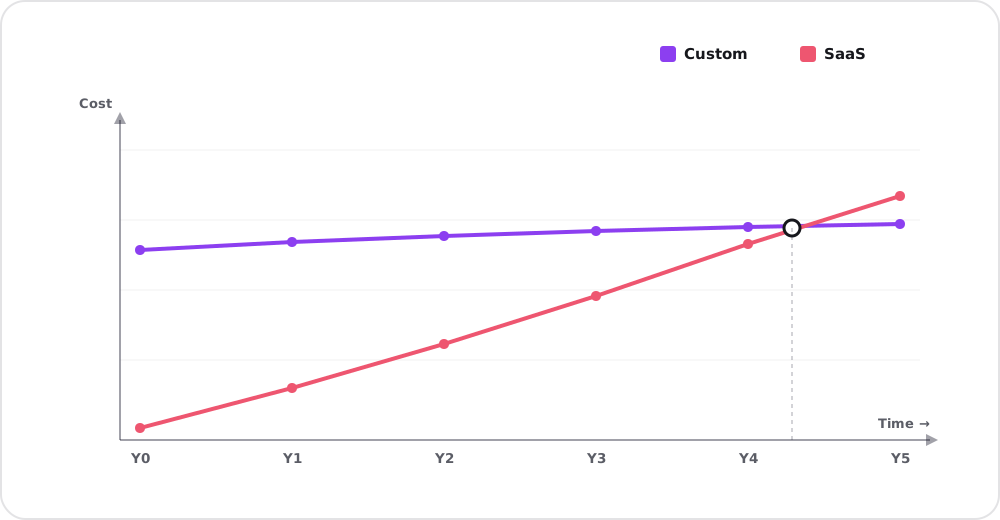
Illustrative: SaaS is cheaper to start, but its subscriptions keep climbing — given enough time the cumulative cost can overtake a custom build.
The headline numbers — a monthly subscription versus a build quote — are only the tip. The costs that actually decide this comparison sit below the surface.
Off-the-shelf SaaS looks cheap because the starting price is small, but three costs creep in over time:
- Subscription creep. A few dollars per user per month feels trivial, until you multiply by your whole team, across a dozen tools, for several years. The bill grows with every hire and every renewal.
- Lock-in. Your data and processes get woven into the vendor’s product. Leaving later means migration pain, retraining, and sometimes losing data or functionality you had come to rely on — which is exactly why prices tend to rise at renewal.
- “Almost fits.” The most expensive SaaS problem is the product that does 80% of what you need. The missing 20% gets papered over with spreadsheets, manual steps, and workarounds that quietly cost real time forever.
Custom software looks expensive because the cost is visible and up front, but it is not hidden — it is just earlier:
- Upfront build cost. You pay to design and build before you get any value, and a serious build is a real investment. (We break this down in how much custom software costs.)
- Ongoing maintenance. Software is never finished. It needs hosting, security updates, bug fixes, and changes as your business evolves — whether from an in-house team or a partner.
Neither option is “cheap.” SaaS spreads the cost thin and wide and lets it grow quietly; custom concentrates it up front and keeps it visible. Knowing where the cost lives is half the decision.
Custom vs off-the-shelf SaaS at a glance
| Dimension | Off-the-shelf SaaS | Custom software |
|---|---|---|
| Upfront cost | Low — subscribe and go | High — you pay to build first |
| Time to live | Immediate | Weeks to months |
| Fit to process | Generic — built for the average | Exact — built around your workflow |
| Scaling cost | Grows per user, per month | No per-seat tax |
| Maintenance | Handled by the vendor | Yours (in-house or partner) |
| Ownership | You rent; vendor owns the product | You own software and data outright |
| Integration | Limited to what the vendor allows | Deep — connects to anything you run |
| Main risk | Lock-in and “almost fits” | Upfront cost and maintenance burden |
| Best for | Standard, commodity needs | Unique, differentiating processes |
The hybrid reality: buy commodity, build differentiator
In practice, the choice is rarely all-or-nothing — and treating it that way is how businesses overspend. The pattern that works for most organizations is simple: buy the commodity, build the differentiator.
Use off-the-shelf SaaS for the standard, supporting parts of the business — accounting, email, payroll, document storage, video calls. These are solved problems where a vendor will always do it better and cheaper than you could. Then build custom software only for the processes that are genuinely yours: the unique workflow, the operational engine, the thing customers actually feel and competitors cannot simply buy.
A retailer might run accounting and HR on SaaS while building a custom inventory and fulfillment system that is the real reason their operation is faster than rivals. The art is knowing which parts of your business are commodity and which are advantage — and refusing to overpay to build the former or to compromise the latter.
How to decide
There is no universally correct answer — only the best fit for your situation. Ask these questions honestly:
- How standard is this process? If thousands of businesses do it the same way, a SaaS product probably already does it well. If your process is genuinely unusual, off-the-shelf will fight you.
- Does this software differentiate us? If it is core to how you compete and win, that argues for building. If it is just supporting plumbing, buy it.
- How well does the best available product actually fit? A 95% fit is a clear buy. A 70% fit that forces constant workarounds is a warning sign.
- What will it cost over years, not months? Compare the full subscription bill across your growing team and time horizon against the build-plus-maintenance cost of owning it.
- How important are ownership, control, and integration? If you need to own the data, set the roadmap, or connect deeply to other systems, custom earns its cost.
- How fast do we need it? If you need a solution next week, SaaS wins almost by default. Custom is an investment that pays back over time, not overnight.
A few concrete patterns:
- A standard, common need → buy SaaS. Do not build what you can rent for less.
- A core process that defines how you compete → build custom; that is where the advantage lives.
- A product that fits 90%+ of your needs → buy it, and resist the urge to rebuild for the last 10%.
- A process no product fits, or one tangled in your legacy systems → custom is likely cheaper and saner than fighting a tool that was never meant for you.
- A business with mixed needs → hybrid: buy the commodity, build the differentiator, and right-size each decision on its own merits.
Conclusion
Custom software and off-the-shelf SaaS are not rivals so much as different tools for different jobs. SaaS trades exact fit for speed, low upfront cost, and the relief of someone else maintaining it — ideal for standard, commodity needs. Custom trades convenience for fit, ownership, integration, and the chance to turn a process into a competitive advantage — ideal when the software is central to how you work or win. And for most businesses, the honest answer is both: a hybrid that buys the commodity and builds the differentiator.
The real goal is not to be a “buy” company or a “build” company as a matter of identity — it is to put each part of your business on the option that makes it cheapest to run, best fitted to how you work, and most able to set you apart.
If you would like a second opinion on which of your systems to buy and which to build — and how to size the real cost before you commit — that is exactly the kind of conversation we enjoy. Reach out for a free consultation.
Frequently asked questions
- Should I build custom software or buy off-the-shelf SaaS?
- Buy off-the-shelf SaaS when your need is standard and an existing product fits well — it is faster, cheaper to start, and maintained for you. Build custom when the software is central to how you compete or no product fits your workflow without constant workarounds. Most businesses end up doing both: buying the commodity parts and building only what truly differentiates them.
- Is custom software cheaper than SaaS in the long run?
- It can be. SaaS has a low starting price but its per-user subscriptions keep climbing as your team grows, so the cumulative cost can eventually overtake a custom build. Custom concentrates the cost up front and adds no per-seat tax, but you also carry ongoing hosting and maintenance. The honest answer depends on your team size and time horizon, so compare years rather than months.
- What is vendor lock-in with SaaS and why does it matter?
- Lock-in is when your data and processes become so woven into a vendor's product that leaving is costly. Switching later can mean painful migration, retraining, and sometimes losing data or features you relied on. That dependency is also why SaaS prices often rise at renewal, and it is a key reason some businesses prefer to own their software outright.
- When does it make sense to choose custom software over SaaS?
- Custom makes sense when a process is genuinely unique to you, when the software is the advantage competitors cannot simply buy, or when you need deep integration with existing and legacy systems. It also wins when the best available product only fits around 70% of your needs and forces constant workarounds. If a process is just supporting plumbing, buying is usually the smarter call.
- Who owns the software and data with custom versus SaaS?
- With custom software you own the product and its data outright, and you control the roadmap, priorities, and pace of change. With SaaS you are renting access — the vendor owns the product and decides what gets built and when. If owning your data, setting your own roadmap, or connecting deeply to other systems matters to you, that ownership is a strong argument for building custom.