
Monolith vs Microservices: How Should You Structure Your Application?
A practical guide to monolith vs microservices architecture — what each really means, how they compare on speed, cost, scaling and complexity, and why the modular monolith is the pragmatic middle most teams should start with.
- Software Development
- Architecture
- Microservices
- Monolith

Once you have decided to build custom software, one of the earliest and most consequential questions is not what the application does but how it is put together: do you build it as a single, unified application — a monolith — or as a collection of small, independent services — microservices?
It is a decision that quietly shapes how fast you can ship, how the system scales, how much it costs to run, and how large a team you need to operate it. And it is one the industry routinely gets wrong, usually by reaching for microservices because they sound modern rather than because the problem demands them. This guide explains what each architecture really is, where each genuinely wins, and why for most teams the honest answer is a third option that sits between them.
What a monolith really is
A monolith is a single application where everything — the user interface, the business logic, and the data-access layer — lives in one codebase and ships as one deployable unit. When you release a change, you deploy the whole thing. When it runs, it runs as one process (or several identical copies of that one process behind a load balancer).
This is how the overwhelming majority of software has always been built, and for good reason. A monolith is simple to understand, simple to run, and simple to change when it is young. A new developer can clone one repository, run it locally, and see the entire system in front of them. A function in one part can call a function in another directly, with no network in between. There is one thing to deploy, one thing to monitor, one place to look when something breaks.
The trouble appears at scale — of code and of people. As a monolith grows to millions of lines and dozens of contributors, its internal boundaries blur. Parts that should be independent become quietly tangled, so a change in one corner can break a distant one. The whole thing must be deployed together, so one risky change holds up everyone else’s safe ones. And you can only scale it as a single block: if just the checkout path is under load, you still have to run more copies of the entire application to cope.
What microservices really are
Microservices take the opposite stance. Instead of one application, you build many small ones, each responsible for a single business capability — orders, users, billing, notifications — and each owning its own data. They run as separate processes, deploy independently, and talk to one another over the network through well-defined APIs, often behind an API gateway that routes requests to the right service.
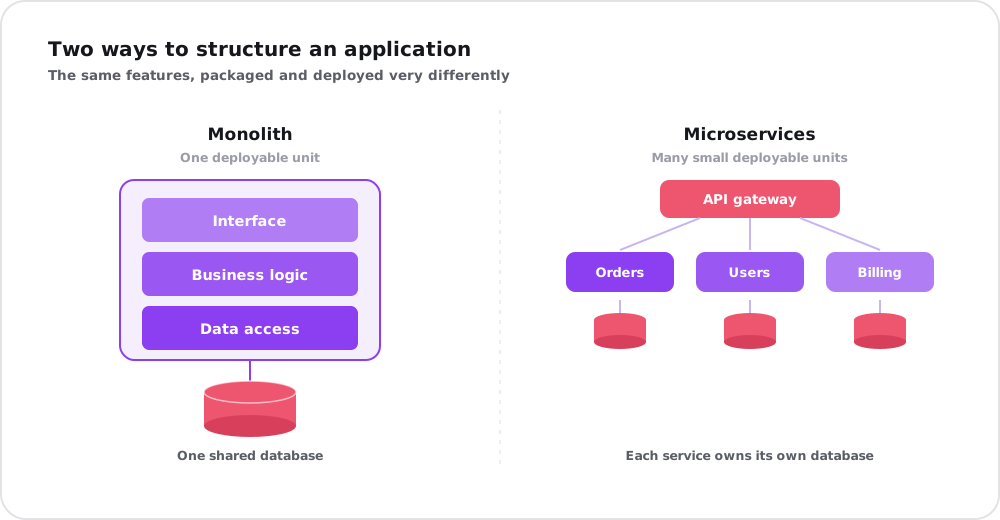
Same features, two very different shapes: the monolith packages everything into one unit over a shared database; microservices split the system into independently deployable services, each with its own data.
The appeal is real. Each service can be deployed on its own schedule, so a small team can ship its piece without coordinating a release across the whole company. Each can be scaled independently — run twenty copies of the load-heavy service and one copy of the quiet one. Each can even use the technology that fits it best. And a failure in one service can, if you design for it, be contained instead of taking down everything.
But every one of those benefits is bought with distributed-systems complexity, and that bill is larger than it first looks. Calls that were once instant in-process function calls become network requests that can be slow, fail, or arrive out of order. Data that lived in one database is now spread across many, so keeping it consistent — and answering a question that spans several services — becomes real work. Testing, debugging, and tracing a single user request now means following it across process boundaries. And you need the operational machinery — automated deployment, monitoring, service discovery — to run dozens of moving parts instead of one. None of this is insurmountable, but none of it is free.
The honest trade-off
The cleanest way to see the decision is side by side. Notice that the columns are almost mirror images: microservices’ strengths are a monolith’s weaknesses, and the reverse holds too. There is no free lunch — only a trade you make deliberately.
| Dimension | Monolith | Microservices |
|---|---|---|
| Initial speed | Fast — one codebase, ship quickly | Slow — infrastructure first |
| Deployment | All at once | Each service independently |
| Scaling | The whole app as one block | Per service, precisely |
| Operational complexity | Low — one thing to run | High — many moving parts |
| Debugging | In one place | Across the network |
| Data consistency | Straightforward (one database) | Hard (many databases) |
| Team fit | One team, or a few coordinated | Many autonomous teams |
| Best when | Most products, especially early | Large org, large scale, distinct needs |
The decisive variables are rarely technical taste. They are scale, team size, and maturity. Microservices solve organizational problems — letting many teams work and release without stepping on each other — far more than they solve raw technical ones. If you do not yet have many teams, you are paying the cost of that solution without having the problem it solves.
The modular monolith: the pragmatic middle
The framing of “monolith versus microservices” is a false binary, and the most useful architecture for most teams sits between them: the modular monolith.
A modular monolith is still a single deployable application — so you keep simple deployment, simple debugging, and one database to reason about — but internally it is organized into clear, loosely coupled modules with well-defined boundaries, as if each module were a future service. Code in one module does not reach into another’s internals; it goes through a defined interface. You get much of the discipline and team autonomy people want from microservices, without taking on the distributed-systems tax before you need to.
Crucially, this is the architecture that keeps your options open. Because the boundaries are already clean, the day a specific module genuinely needs to scale or deploy on its own, you can lift it out into its own service with far less pain than carving a service out of a tangled big-ball-of-mud monolith. The pattern most mature organizations land on is exactly this: one well-structured core, with a handful of services peeled off for the few parts that truly warrant it — not fifty uniform services because a diagram looked tidy.
This is also why so many teams that rushed into microservices have quietly merged services back together. The complexity overwhelmed the benefit. Starting modular and splitting later — only where the evidence demands it — is almost always cheaper than starting distributed and trying to consolidate.
How to choose
There is no universally correct answer, only the best fit for your situation. Weigh these honestly:
- Team size and structure. One team, or a few who coordinate well → a monolith (ideally modular). Many independent teams that need to ship without blocking each other → microservices start to earn their keep.
- Stage and speed. Early-stage products need to find product–market fit before they need to scale to millions. Ship a modular monolith now; you are not Netflix yet, and pretending you are is expensive.
- Scale, and where it lands. If only one part of the system carries extreme, uneven load, that part is a candidate to split out — while the rest stays monolithic. Uniform, moderate load rarely justifies splitting anything.
- Operational maturity. Microservices demand strong automated deployment, monitoring, and on-call discipline. Without that foundation, they multiply outages instead of containing them.
- Honest cost. More services means more infrastructure and more engineering time to operate — a real line item, much like the total cost of running software and the cloud-versus-on-premise decision it sits alongside. Pay it when it buys you something.
A simple rule of thumb: start with a modular monolith, and extract a microservice only when a specific, measured pressure — a part that must scale alone, a team that must deploy alone, a capability with radically different reliability needs — makes the split pay for itself. Architecture should follow real constraints, not fashion.
Conclusion
Monoliths and microservices are not a question of old versus modern. They are two points on a spectrum of trade-offs between simplicity and independence. A monolith gives you speed, low operational cost, and one system to reason about — exactly what a young or mid-sized product needs. Microservices give you independent scaling and team autonomy at the price of real distributed-systems complexity — worth it once you are large enough to have the problems they solve.
For most teams, the wise path is the one in the middle: build a modular monolith with clean internal boundaries, run it simply, and split off services later, one at a time, only where the evidence demands. That keeps today cheap and tomorrow open — which is what good architecture is supposed to do.
If you would like a second opinion on how your next system should be structured — and how to keep it simple now without painting yourself into a corner later — that is exactly the kind of conversation we enjoy. Reach out for a free consultation.