
SEO for Indonesian Businesses: A Practical Guide to Getting Found
How search engine optimization works for businesses in Indonesia — the foundations (technical, content, local, links), what to prioritize first, and how to measure it.
- Digital Marketing
- SEO
- Content

Most Indonesian businesses already know their customers are searching online — for a plumber in Bandung, a coffee supplier in Surabaya, an accounting firm in Jakarta. The harder question is whether those customers find you or a competitor when they type the query. That gap is what search engine optimization (SEO) exists to close: the practice of making your website easier for search engines to understand, trust, and rank, so the right people reach you without you paying for every click.
This guide explains how SEO actually works for businesses operating in Indonesia, the four foundations that matter, what to fix first, and — just as important — how to measure whether any of it is working. There are no shortcuts here and no “guaranteed number one” promises. SEO is compounding work, not a switch you flip.
Why SEO matters in Indonesia specifically
Search behaviour in Indonesia has a few traits that shape how SEO should be done, and ignoring them is a common reason local campaigns underperform.
The first is language. Indonesians search in a mix of Bahasa Indonesia, English, and the informal blend in between. Someone might search “jasa desain website murah” one moment and “best CRM software” the next. Strong SEO matches the language your customers actually use for each query — not a literal translation of your English marketing copy.
The second is mobile-first. The overwhelming majority of searches in Indonesia happen on phones, often on variable mobile connections. Google indexes the mobile version of your site first, so a page that is fast and readable on a mid-range Android phone matters far more than one that only looks good on a desktop.
The third is local intent. A huge share of commercial searches carry an implied “near me” — people want a business they can call, visit, or order from today. For most Indonesian businesses, showing up in local results is where the revenue actually is.
The four foundations of SEO
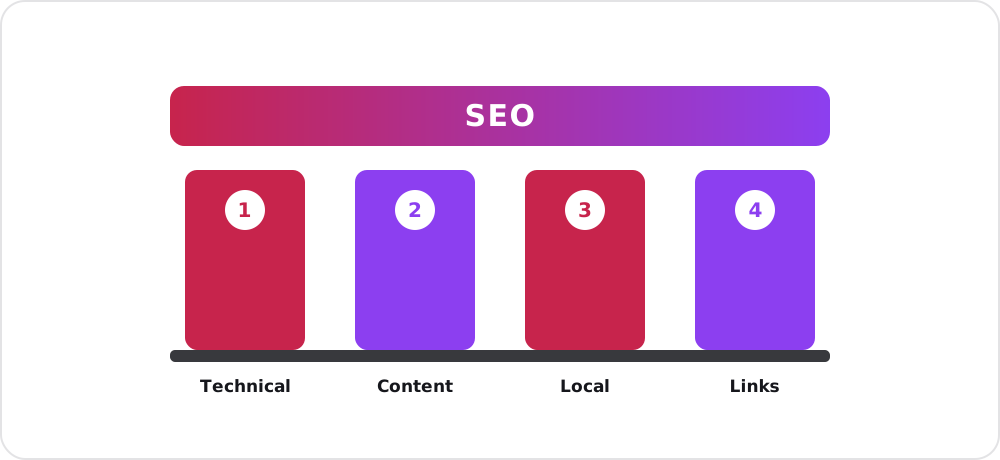
The four pillars that hold up search visibility — each is covered below.
SEO is not one thing. It rests on four pillars, and a weakness in any one limits the others.
Technical SEO
Technical SEO is everything that lets a search engine crawl, render, and index your site cleanly. If Google cannot access or understand your pages, nothing else matters. The core checklist:
- Speed. Pages should load quickly on mobile. Compress images, avoid heavy scripts, and use sensible hosting — slow sites lose both rankings and visitors.
- Mobile-friendliness. Text readable without zooming, tap targets large enough, no horizontal scrolling.
- Crawlability and indexing. A clean URL structure, a working
sitemap.xml, and arobots.txtthat does not accidentally block important pages. - Secure and stable. HTTPS everywhere, no broken links, no duplicate versions of the same page competing with each other.
Technical SEO rarely wins customers on its own, but technical problems quietly cap everything else you do.
Content and keywords
Content is what actually answers the searcher’s question — and keywords are how you discover which questions to answer. The goal is to understand the intent behind a search, then build pages that satisfy it better than the alternatives.
In practice this means researching the terms your customers use (in Bahasa Indonesia, English, or both), grouping them by intent, and creating clear, genuinely useful pages around them — service pages, location pages, and articles that answer real questions. Avoid the old habit of stuffing the same keyword repeatedly; modern search rewards depth and clarity, not repetition.
Local SEO
For any business that serves a specific city or region, local SEO is often the highest-leverage pillar. The centrepiece is a complete, verified Google Business Profile — your listing in Google Maps and the local results. Fill in every field: categories, hours, photos, services, and a real description.
Just as important is NAP consistency — your Name, Address, and Phone number written identically everywhere they appear online: your website, your Google Business Profile, directories, and social pages. Inconsistent details (a different phone format here, an abbreviated street name there) confuse search engines and weaken local ranking. Genuine customer reviews and locally relevant content round out the picture.
Backlinks and authority
Backlinks — links from other websites to yours — act as votes of confidence. Search engines treat a link from a reputable, relevant site as a signal that your content is trustworthy. A handful of quality links from respected Indonesian publications, industry bodies, or partners is worth far more than hundreds of low-quality links bought in bulk, which can actively harm you. Authority is earned slowly: by being genuinely useful, getting cited, and building real relationships.
What to prioritize first
You cannot do all four pillars at once, and you should not try. A sensible order for most Indonesian businesses:
- Fix the technical foundation. Make sure the site is fast, mobile-friendly, secure, and fully indexable. There is no point ranking content on a site Google struggles to read.
- Build the content that matches intent. Create the core service and location pages, then expand into helpful articles. This is the work that compounds.
- Establish local presence. Claim and complete your Google Business Profile and clean up NAP consistency — frequently the fastest path to real enquiries.
- Earn authority over time. Pursue quality backlinks once you have content worth linking to. This is ongoing, not a one-off project.
Technical and content come first because they are the foundation everything else builds on. Local and links amplify a site that is already sound; they cannot rescue one that is not.
Realistic timelines
This is where honesty matters most. SEO works in months, not days. A new or neglected site typically needs three to six months to show meaningful movement, and competitive terms can take longer. Search engines need time to crawl and re-evaluate your site, content needs time to mature and earn trust, and links accumulate gradually.
Anyone promising you the top spot in two weeks is either misunderstanding how search works or misleading you. The upside of that patience is durability: unlike paid ads, which stop the moment you stop paying, SEO results keep delivering long after the work is done.
Measuring results
If you cannot measure it, you cannot improve it. Focus on a few signals that actually connect to the business:
- Google Search Console. Free and essential — it shows which queries bring you impressions and clicks, your average position, and any indexing problems.
- Rankings. Track where you appear for your priority keywords over time. Useful as a trend, not an obsession.
- Organic traffic. Visitors arriving from unpaid search, viewable in your analytics. The clearest sign that the foundations are working.
- Conversions. The number that truly matters — enquiries, calls, bookings, or sales from organic visitors. Traffic without conversions is vanity.
Treating these as connected metrics, rather than isolated numbers, turns SEO into a measurable investment. This is where a disciplined approach to data and analytics pays off: the goal is not more traffic for its own sake, but more of the right traffic that becomes revenue.
Common mistakes to avoid
- Chasing rankings instead of customers. Ranking for terms nobody searches, or that never convert, feels productive but earns nothing.
- Ignoring mobile. A site that is slow or awkward on phones loses most of the Indonesian market.
- Keyword stuffing. Repeating phrases unnaturally reads badly to humans and is discounted by search engines.
- Buying cheap backlinks. Bulk, low-quality links are a liability, not a shortcut.
- Neglecting the Google Business Profile. For local businesses, an incomplete or unclaimed listing is leaving enquiries on the table.
- Expecting instant results. Giving up after a month, right before the work starts to pay off, is the most expensive mistake of all.
Conclusion
SEO for Indonesian businesses is not magic and it is not a quick win — it is steady, compounding work across four foundations: a sound technical base, content that genuinely answers what people search, a strong local presence, and authority earned over time. Get the order right, measure honestly, and give it the months it needs, and search becomes one of the most durable sources of customers a business can have.
If you would like help building that foundation — or an honest assessment of where your site stands today — that is exactly what our digital marketing work is for. Get in touch for a free consultation.