
Taking AI from Pilot to Production
How to turn an impressive AI demo into a system you can trust in front of real users — answers grounded in your own data, gated on measurable quality, and red-team-tested for safety.
- Artificial Intelligence
- Data Analytics
- AI Safety

The situation
AI demos are easy; AI you can trust is not. A model that dazzles in a meeting will, left unguarded, also invent facts, leak sensitive data, or get talked into doing something it shouldn’t. The gap between a convincing pilot and a dependable production system is exactly the part most projects skip — and it is the part that decides whether you can ever put the thing in front of a real customer.
How we approach it
We treat a production AI system the way we’d treat any system that has to be trusted: it has to prove it works before it ships an answer.
- Ground it in your data. Retrieval-augmented generation answers from your own knowledge, not the model’s guesswork — so responses are accurate, current, and traceable to a source.
- Gate it on measurable quality. Every answer is scored before it ships; anything that falls below a faithfulness threshold is blocked rather than shown. Quality becomes a number that stops a release, not a hope that rides along with it.
- Red-team it for safety. Before users ever see it, the system is attacked — jailbreaks, prompt injection, attempts to leak personal data — and measured against recognised standards like the OWASP Top 10 for LLM Applications.
How it works
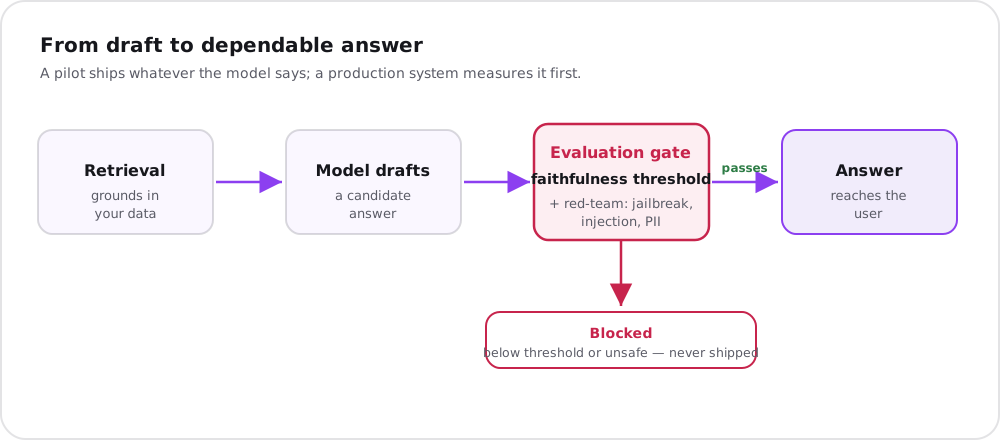
The gate is the point: a pilot ships whatever the model says; a production system measures the answer first and refuses the ones that fall short.
The difference between a pilot and a production system is that middle gate. By turning quality and safety into measurements that block a release — not assurances that travel with it — the same discipline that protects a payments API gets applied to a language model. The result is AI you can actually put your name next to.
The proof
This is the practice behind Pangaea — production RAG held to a faithfulness threshold of ≥ 0.90, red-team-tested against the OWASP Top 10 for LLMs and the NIST AI Risk Management Framework, with client data kept inside the client’s own environment.
If you have an AI pilot that needs to become something you can trust, that is exactly what our Data Analytics team does. Let’s talk.