
Conversion Rate Optimization: How to Turn Website Traffic Into Customers
What conversion rate optimization really is, why fixing your funnel often beats buying more traffic, the friction that quietly kills conversions, and how to run CRO as a program rather than a one-off tweak.
- Digital Marketing
- CRO
- Conversion Optimization
- A/B Testing

You spent money to get people to your website — on search rankings, on paid ads, on content and social. The visitors arrived. And then most of them left without buying, signing up, or getting in touch. That gap — between the traffic you paid for and the customers you actually won — is the single most expensive leak in most marketing budgets, and it is exactly what conversion rate optimization (CRO) exists to close.
CRO is not about getting more visitors. It is about getting more value from the visitors you already have. This guide explains what a conversion rate is, why improving it often beats buying more traffic, where visitors quietly slip away, and how to run CRO as a disciplined program instead of a lucky guess.
What conversion rate optimization actually is
A conversion is any action you want a visitor to take: a purchase, a form submission, a demo request, a newsletter sign-up, a phone call. Your conversion rate is simply the share of visitors who take that action:
Conversion rate = conversions ÷ visitors × 100%
If 1,000 people visit and 20 buy, your conversion rate is 2%. Conversion rate optimization is the ongoing practice of raising that number — systematically finding what stops people from converting and removing it.
The reason CRO matters so much is leverage. Doubling your traffic usually means doubling your ad spend or waiting months for SEO to compound. Doubling your conversion rate costs nothing in extra traffic — the visitors are already there — and it makes every future marketing dollar work harder at the same time. A site that converts at 4% instead of 2% earns twice the return on the identical ad budget.
Where visitors leak away: the funnel
Almost nobody buys on the first click. Visitors move through stages — arriving, engaging, showing intent, and finally converting — and at every step, some drop out. Picturing this as a funnel shows you where the leaks are worst.
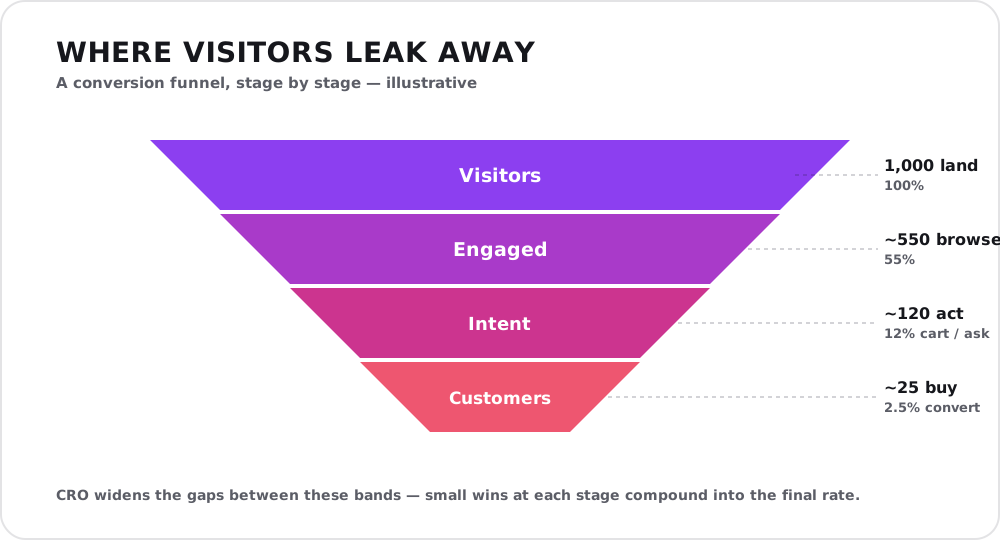
Illustrative figures. The absolute numbers vary by business, but the shape is universal — each stage loses people, and CRO is the work of losing fewer of them.
The power of the funnel view is that it turns a vague goal (“get more sales”) into a set of specific, measurable questions. Are people bouncing the moment they land? The leak is at the top — probably message, speed, or relevance. Do they browse but never add to cart? The leak is in the middle — product, pricing, or trust. Do they reach checkout and abandon it? The leak is at the bottom — friction, cost surprises, or a clumsy form. You fix the biggest leak first, because a 10-point improvement at your worst stage moves the final number far more than a 1-point polish at a stage that already works.
The friction that quietly kills conversions
Most lost conversions are not caused by an unwilling visitor — they are caused by friction: small frustrations that add up until the visitor gives up. The good news is that friction is fixable, and the common culprits repeat across almost every site.
| Conversion killer | What the visitor feels | The fix |
|---|---|---|
| Slow pages | “This is taking forever” — and they leave | Cut load time; aim for under ~2.5s on mobile |
| A weak or mismatched headline | “This isn’t what I clicked for” | Match the message to the ad or search that sent them |
| No trust signals | “Can I actually rely on this company?” | Reviews, logos, case studies, guarantees, clear contact |
| Long or clumsy forms | “Why do they need all this?” | Ask only for what’s essential; every field costs you |
| A buried or vague call to action | “What am I supposed to do now?” | One clear, primary action per page |
| Hidden costs at checkout | “Shipping is how much?” | Show total cost early; no surprises at the last step |
| A broken mobile experience | “I can’t even tap this” | Design mobile-first — most visitors are on a phone |
Notice that none of these require more traffic or a bigger budget. They are removals — of doubt, of effort, of surprise. That is the essence of CRO: you are not persuading harder, you are getting out of the visitor’s way.
Speed is a conversion lever, not just a tech metric
Of all the friction points, page speed is the one businesses most often underestimate — because it looks like an engineering concern rather than a marketing one. It is both. A visitor who waits too long simply leaves, and the drop-off is steep and measurable.
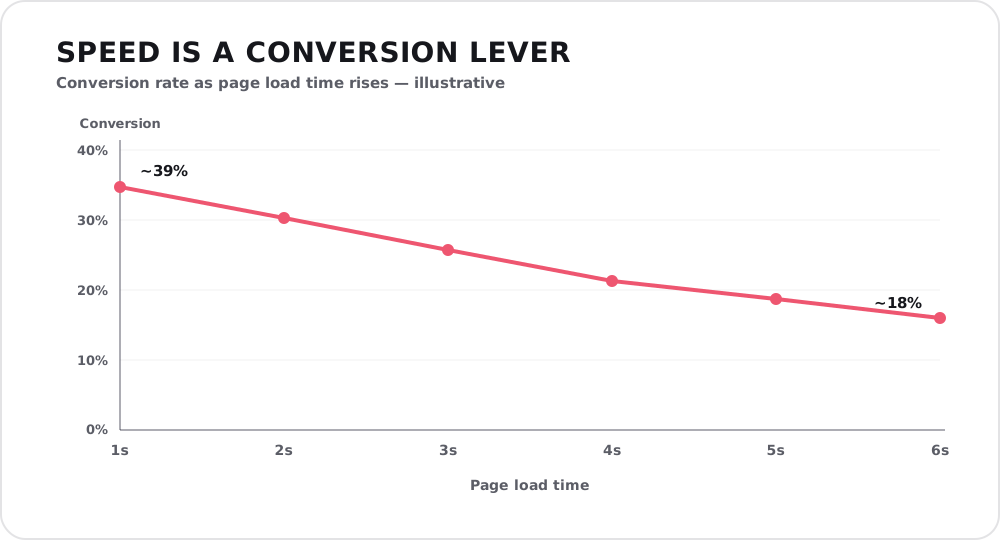
Illustrative pattern drawn from widely reported industry data. The exact figures depend on your audience and offer, but the direction never changes: every extra second of load time costs you conversions.
Because more than half of all web traffic now arrives on mobile — and mobile consistently converts lower than desktop — speed on a mid-range phone over a patchy connection is where much of this battle is won or lost. Compressing images, trimming scripts, and getting the main content to render fast is not a “nice to have.” It is one of the highest-return changes most sites can make.
CRO is a program, not a one-off tweak
The biggest mistake in CRO is treating it as a single redesign or a one-time “let’s make the button green” decision. Real gains come from a loop you run continuously:
- Measure. Use analytics to find where the funnel leaks worst. Watch bounce rates, exit pages, and abandoned checkouts. Let the data — not opinion — point to the biggest problem.
- Understand. Look at why. Session recordings, heatmaps, on-site surveys, and plain user testing reveal the friction the numbers only hint at.
- Hypothesize. Write a clear, testable statement: “Shortening the checkout form from nine fields to four will increase completed orders, because the current form is where most people abandon.”
- Test. Run an A/B test — show half your visitors the current version (the control) and half the new version (the variant), then compare which converts better. Because both versions run at the same time on real, randomly split traffic, the result reflects behavior, not guesswork.
- Decide and repeat. Keep the winner, discard the loser, learn from both, and move to the next-biggest leak.
The discipline matters more than any single trick. Teams that run even one or two structured tests a month tend to compound meaningful gains over a year — precisely because they are learning what their customers respond to, rather than copying a tactic that worked for someone else’s audience.
What to test first
You do not have unlimited time, so spend it where the leverage is highest. Prioritize changes that are close to the money and cheap to try:
- Message match between your ads or search snippets and the page they land on.
- The primary call to action — its wording, prominence, and whether there is exactly one.
- Form length — remove every field you do not truly need right now.
- Trust signals above the fold — reviews, guarantees, and recognizable proof where hesitation happens.
- Page speed, especially on mobile.
Resist the urge to test trivia (a shade of blue) before you have fixed the obvious leaks. Big friction first, fine-tuning later.
What counts as a “good” conversion rate?
Business owners always ask for the magic number. The honest answer is that it depends — on your industry, your traffic source, your price point, and what you count as a conversion. A high-consideration B2B service and an impulse-buy retail product live in completely different ranges, and a rate that is excellent for one would be poor for the other.
So chase the right benchmark: your own last quarter. Industry averages are useful for a rough sanity check, but the only comparison that reliably tells you whether CRO is working is your site against itself over time. Up and to the right, month after month, is the goal — not some borrowed number from a different business with a different audience.
Bringing it together
Conversion rate optimization is the quiet multiplier behind every other marketing investment. SEO and paid search fill the top of your funnel; CRO decides how much of that hard-won traffic actually becomes revenue. Neglect it, and you are paying to pour visitors into a leaky bucket. Invest in it, and every future click — free or paid — is worth more.
The work is not glamorous: measure honestly, find the biggest leak, form a clear hypothesis, test it against real traffic, keep what wins, repeat. But done consistently, it is one of the highest-return activities in all of digital marketing — because it improves the return on everything else you do.
If you would like help finding where your funnel leaks — and turning more of your existing traffic into customers — that is exactly the kind of work our digital marketing team does. Reach out for a free consultation and we will take a look together.