
Email Marketing for Business: The Owned Channel That Still Delivers
Email is the one marketing channel you actually own. Here is how email marketing really works — building a permission list, segmentation, lifecycle automation, deliverability, and the metrics that matter.
- Digital Marketing
- Email Marketing
- Automation
- Deliverability
Every other marketing channel is rented. You borrow reach from a search engine, an ad network, or a social platform — and the moment the algorithm shifts, the bid rises, or an account gets suspended, that reach can vanish overnight. Email is different. When someone gives you their address, you hold a direct line to them that no platform sits between. That is why, decade after decade, businesses that quietly build an email list keep outperforming the ones chasing the newest channel.
Email is routinely written off as old-fashioned, yet it remains one of the highest-return activities in digital marketing. This guide explains what email marketing actually is in practice — how to build a list you own, why segmentation and automation matter more than any subject line, what “deliverability” really means, and which numbers tell you the truth about whether it is working.
Why email still outperforms the hype
The case for email is not nostalgia — it is economics. Three structural advantages keep it ahead:
- You own the audience. Your list is an asset that travels with you across rebrands, platform changes, and ad-policy shakeups. Followers and rankings are borrowed; subscribers are yours.
- It reaches people who already raised their hand. A subscriber asked to hear from you. That intent makes email far warmer than an interruption ad shown to a stranger.
- It is direct and personal. Email lands in a private space, one-to-one, and can be tailored to exactly where each person is in their journey.
It helps to see email against the channels most businesses lean on. Each has a role, but only one of them is genuinely yours.
| Channel | Who owns the audience | Cost model | Longevity of reach |
|---|---|---|---|
| You | Low, mostly fixed | Durable — the list is an asset | |
| Paid search | The ad network | Pay per click, rising | Stops the moment you stop paying |
| Social media | The platform | Free + paid boosts | At the mercy of the algorithm |
| Organic search | The search engine | Effort over time | Strong but slow and volatile |
Paid and social channels are worth running — but they are leased reach. Email is the one audience you take with you.
What email marketing actually is
Email marketing is the practice of sending relevant messages to people who have given you permission to contact them, in order to build a relationship that eventually leads to a sale, a renewal, or a referral. The word doing the heavy lifting there is permission. This is not spam and it is not buying a list of strangers — both destroy your reputation and, increasingly, break the law.
It splits into two broad kinds of message. Broadcasts (or campaigns) are one-off sends to a segment — a product launch, a newsletter, a seasonal offer. Lifecycle emails are automated messages triggered by what a person does — a welcome after signup, a nudge after an abandoned cart, a check-in after a period of silence. The best programs lean heavily on the second kind, because automated, well-timed messages do the work while you sleep.
Build a list you actually own
Everything starts with the list, and a good list is grown, never bought. Bought lists are full of people who never asked for you; they tank your deliverability and can breach privacy law. Grow instead:
- Offer a clear reason to subscribe. A useful lead magnet — a checklist, a short guide, a discount, early access — gives people a concrete reason to hand over an address. “Sign up for our newsletter” rarely does.
- Ask in the right places. A signup form on your highest-traffic pages, at the end of your best articles, and at checkout captures people at the moment their interest peaks.
- Use confirmed opt-in. Ask new subscribers to click a confirmation link. It costs you a few signups but guarantees real, engaged addresses — and protects your sender reputation.
- Set expectations up front. Tell people what they will get and how often. Meeting that promise is what keeps them from unsubscribing later.
A smaller list of people who genuinely want to hear from you is worth far more than a big list that ignores you — and it costs less to send to, too.
Segmentation: stop blasting everyone
The fastest way to make email work harder is to stop sending the same thing to everyone. Segmentation means grouping subscribers by what you know about them — what they bought, what they clicked, where they are in their lifecycle, what they told you they care about — and tailoring the message to the group.
The difference is stark. A single blast to your whole list treats a first-day subscriber the same as a five-year customer. A segmented program sends the new subscriber an introduction and the loyal customer an upgrade — each message relevant, each far more likely to be opened and acted on. You do not need dozens of segments to start; even splitting “new” from “existing” and “engaged” from “gone quiet” lifts results immediately.
Lifecycle automation: the emails that run themselves
Once you can segment, automation is what turns email from a chore into a system. A lifecycle automation is a sequence that fires automatically based on a trigger — no one has to press send. You build it once, and it works for every new subscriber from then on. A handful of automations covers most of the value:
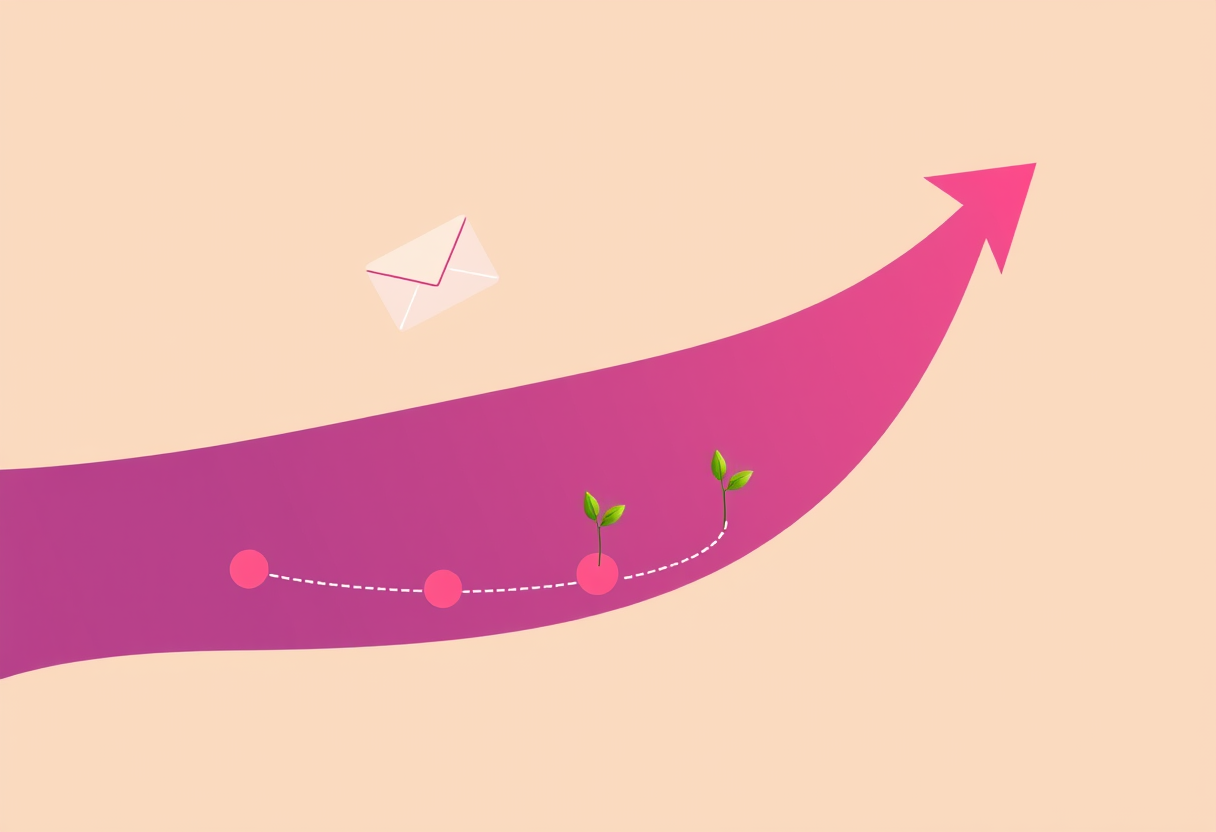
A lifecycle automation is built once and grows with every new subscriber — each stage nudging the relationship a little further along.
| Automation | Triggered when… | Job it does |
|---|---|---|
| Welcome series | Someone subscribes | Introduce you, set the tone, convert |
| Onboarding | A customer signs up or buys | Help them get value quickly |
| Abandoned cart | A checkout is started, not finished | Recover a sale about to be lost |
| Post-purchase | An order is completed | Thank, cross-sell, ask for a review |
| Re-engagement | A subscriber goes quiet | Win back attention before they leave |
These sequences are where email quietly compounds. A welcome series greets every new subscriber at their most interested; an abandoned-cart nudge recovers revenue that would otherwise walk away. Because they run on triggers rather than a calendar, they scale with your audience at no extra effort — the same discipline that makes conversion rate optimization so powerful applies here: small, systematic nudges at the right moment add up.
Deliverability: the unglamorous work that decides everything
You can write the perfect email, but if it lands in spam — or never arrives — none of it matters. Deliverability is whether your messages actually reach the inbox, and in practice it is decided by boring, technical foundations far more than by clever copy.
Three email-authentication records are now the price of entry, not an optimization. SPF tells receiving servers which servers are allowed to send mail for your domain. DKIM adds a cryptographic signature that proves a message truly came from you and was not tampered with. DMARC ties the two together and tells inboxes what to do with mail that fails the checks. Without them, major providers increasingly send you straight to spam — or reject you outright.
Beyond authentication, deliverability rewards good habits: send only to people who opted in, remove addresses that bounce or never engage, make unsubscribing easy (fighting it just trains people to hit “report spam,” which is far worse), and warm up a new sending domain gradually. List hygiene is not housekeeping you do when you get around to it — a stale, unengaged list actively drags down every send to everyone else.
Measure what actually matters
Email is beautifully measurable, which makes it easy to fixate on the wrong number. Open rate — long the headline metric — has become unreliable, because privacy features on many mail clients now pre-load images and report opens that never happened. Treat it as a loose signal, not a verdict.
The numbers that tell the truth sit further down the funnel:
- Delivery and inbox placement — did it arrive, and did it land in the inbox rather than spam? This is the foundation everything else rests on.
- Click-through rate — did the content earn a real action? A far better health check than opens.
- Conversion rate — did the click lead to the outcome you actually wanted?
- Revenue per recipient — the honest bottom line: what each send is worth divided across everyone who received it.
- Unsubscribe and complaint rates — the early warning system. A spike means you are sending too often, to the wrong people, or the wrong thing.
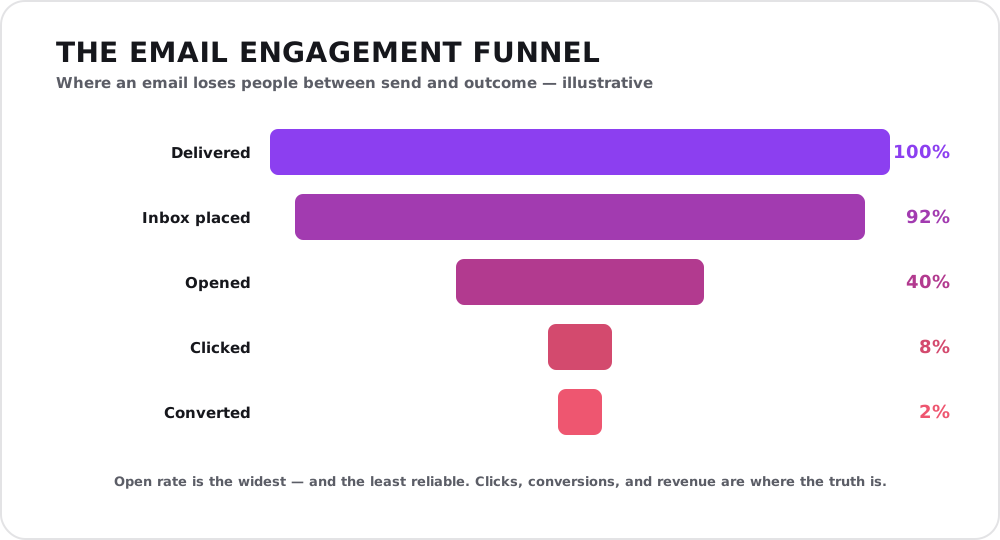
Illustrative figures — the exact rates vary by industry, list quality, and offer. The shape is the point: each step loses people, so the numbers worth optimizing sit near the bottom, not at the top.
Watching the whole funnel — from delivered, to opened, to clicked, to converted — shows you exactly where messages lose people, and where a small fix pays off most.
Common mistakes to avoid
- Buying or scraping lists. It wrecks deliverability and reputation, and it is illegal in many places. There are no shortcuts to a real audience.
- Sending everyone the same thing. Irrelevance is the top reason people unsubscribe. Segment first.
- Chasing volume over relevance. More sends do not mean more revenue; they usually mean more complaints and a worse sender reputation.
- Ignoring mobile. Most email is read on a phone. If it does not render cleanly on a small screen, it does not work.
- Never cleaning the list. Holding on to dead addresses to keep the count high quietly poisons your deliverability for everyone who is engaged.
Conclusion
Email is not the flashiest channel, and that is precisely why it endures. While paid channels lease you attention that disappears the moment the budget does — the trade-off at the heart of paid search — email lets you build something you own: a direct, permission-based relationship with people who chose to hear from you. Get the fundamentals right — grow a real list, segment it, automate the lifecycle, protect deliverability, and measure the numbers that matter — and email becomes the quiet engine that keeps returning value long after a campaign ends.
If you would like help turning email into a dependable channel for your business — from setting up authentication properly to designing the automations that do the work — reach out for a free consultation. It is exactly the kind of practical, high-leverage work we enjoy.