
What Is Technical Debt — and What Is It Quietly Costing Your Business?
Technical debt is the hidden interest you pay every time software cuts a corner. Here is what it is, how it compounds, the four kinds worth telling apart, and how to manage it.
- Software Development
- Technical Debt
- Engineering
- Strategy

Every team building custom software makes a quiet trade dozens of times a week: ship it the fast way now, or the clean way that takes a little longer? Pick the fast way often enough and the software still works — but something invisible starts to accumulate underneath it. The next change takes a bit longer. Then a bit longer still. That drag has a name: technical debt.
It is one of the most useful ideas in software, and one of the most misunderstood by the people paying for the software. Treated well, a little debt is a smart financing tool that buys speed when speed matters. Ignored, it compounds like an unpaid credit-card balance until a team that used to ship in days is spending most of its time just keeping the lights on. This article explains what technical debt actually is, why it compounds, the four kinds worth telling apart, and how to keep it on a leash.
The metaphor that makes it click
The term was coined by programmer Ward Cunningham, and the analogy is exact. Borrowing money lets you do something now that you could not otherwise afford — and that is fine, as long as you pay it back. But if you only ever pay the interest, the principal never shrinks, and the interest keeps coming out of every future paycheck.
Software works the same way. A shortcut — a copy-pasted block instead of a shared function, a missing test, a “temporary” workaround that outlives everyone who remembers why it exists — lets you ship sooner. That is the loan. The interest is everything that shortcut makes harder afterward: every future change to that area is slower, riskier, and more likely to break something. You pay that interest on every single feature you build near the debt, forever, until someone goes back and cleans it up.
The crucial insight for a business owner is that technical debt is not the same as bad code. Debt can be a perfectly rational decision — borrowing speed to hit a market window or validate an idea. The danger is not that it exists; it is that it is invisible on every dashboard a non-engineer looks at, so it grows silently until the symptoms are impossible to miss.
Why it compounds instead of staying still
Debt would be easy to live with if it stayed a fixed size. It does not. It compounds, for a simple structural reason: new work is built on top of old work. A shortcut taken in a core module is not paid once — it is paid again every time anyone touches anything that depends on that module. As the system grows, more and more of it leans on the shaky part, so the interest rate rises with the size of the codebase.
That is why the effort to ship “one more feature” does not stay flat over a product’s life. In a codebase where debt is paid down as you go, the cost of change stays roughly level for years. In one where it is ignored, the same-sized feature gets steadily more expensive to deliver — until teams quote weeks for what used to take an afternoon.
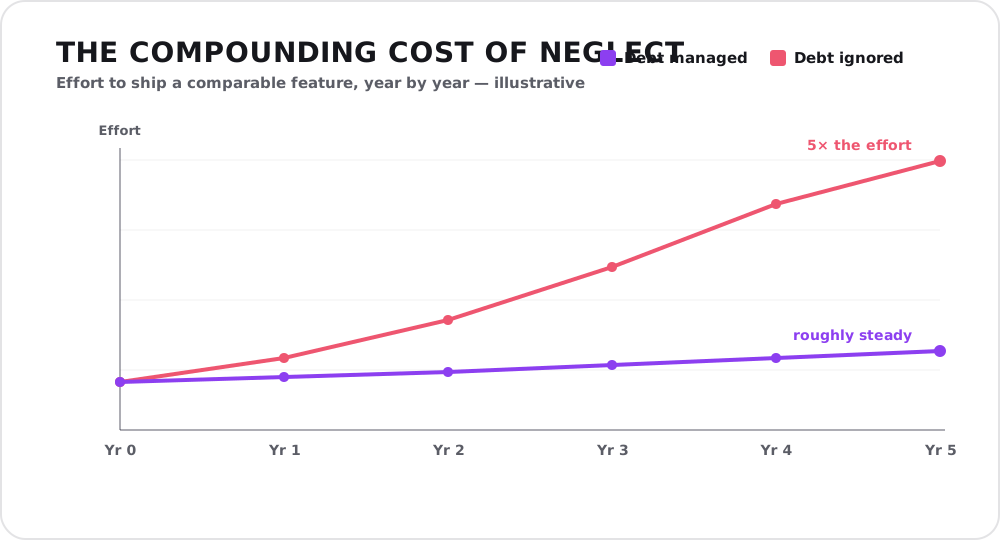
Illustrative figures — but the shape is the point. Managed debt keeps the cost of change flat; ignored debt bends the curve upward until most of the team’s capacity is spent servicing interest instead of building.
Industry studies put real numbers on that curve: analysts consistently estimate that organizations spend somewhere between a fifth and two-fifths of their entire engineering capacity servicing technical debt rather than building new value. For a five-person team, losing a third of the week is not a rounding error — it is a silent tax on everything you are trying to ship.
The four kinds of technical debt
Not all debt is equal, and the most useful map — adapted from Martin Fowler — sorts it along two questions: was the shortcut deliberate or accidental, and was it prudent or reckless? Those two axes give four very different situations, and they call for very different responses.
| Type | What it looks like | What to do about it |
|---|---|---|
| Deliberate & prudent | “We know the clean way; we’re shipping fast now to hit the launch, and we’ll refactor next sprint.” | Healthy. The right kind of borrowing — as long as you actually schedule the payback. |
| Deliberate & reckless | “We don’t have time to do it properly, and we don’t care to.” | Dangerous. Speed with no intent to ever repay. This is how codebases rot on purpose. |
| Inadvertent & prudent | “Now that it’s built, we can see how we should have designed it.” | Normal and unavoidable. Learning shows up as debt; fold the lesson into the next iteration. |
| Inadvertent & reckless | “What’s a shared function? Why would we write a test?” | The costliest kind — debt taken on without even knowing it, usually from a skills or process gap. |
The distinction matters because the fix is different in each box. Deliberate, prudent debt just needs to be tracked and repaid on schedule. Reckless debt — of either kind — signals a process or capability gap that no single refactor will solve; it will simply reappear next quarter unless the way the team works changes.

Unpaid debt turns a system into a tower propped up by workarounds: it still stands, but every new floor you add rests on supports no one fully trusts.
How to spot debt before it becomes a crisis
Because debt is invisible on a feature roadmap, you have to watch for its symptoms. A few reliable ones, in plain business terms:
- Estimates keep drifting up. Comparable features quietly take longer than they did a year ago, with no obvious reason.
- Deploys get scarier. Releases that used to be routine now need a senior engineer on standby, a manual checklist, and a held breath. Deployment frequency dropping is one of the clearest signals something underneath has calcified.
- Small changes cause big breakages. A tweak in one corner mysteriously breaks something unrelated — a sign the pieces are tangled together too tightly.
- Bugs come back. The same class of problem keeps returning because the fixes are patches over a shaky foundation rather than repairs to it.
- Onboarding is slow. New engineers take months, not weeks, to become productive because the “why” lives only in a few people’s heads.
None of these prove disaster on their own. Together, trending in the wrong direction, they are the equivalent of a rising interest bill — and they tend to show up long before anything actually breaks.
A word on AI-generated code
There is a new twist worth naming. AI coding assistants have made writing code almost free — and in doing so shifted the expensive part to understanding it. Code that lands fast but that no one on the team fully grasps is technical debt by another name: it works today, but the cost of safely changing it later is high and hidden. The old discipline — review it, test it, make sure a human owns and understands it — matters more in an AI-assisted workflow, not less.
How to keep debt on a leash
You cannot eliminate technical debt, and trying to would be its own kind of waste — a team that refuses to ever cut a corner ships too slowly to matter. The goal is not zero debt; it is debt you chose on purpose and are paying down on schedule. A few practices that work:
- Make it visible. Debt that lives in engineers’ heads never gets prioritized. Track it like any other work — a register, tickets, a named place on the board — so it competes for attention instead of hiding.
- Budget for it. Many effective teams reserve a standing slice of each cycle — often cited around 15–20% — for paying down debt and maintenance. It stops being the thing that always loses to the next feature.
- Pay as you touch. The cheapest debt to fix is the debt in the code you are already changing. Leave each area a little cleaner than you found it, and the worst-used parts of the system get repaired first, naturally.
- Prevent new reckless debt. Automated quality gates — tests, reviews, checks that run on every change — keep the avoidable, unintentional debt from ever entering. It is far cheaper than paying it back later.
- Tie it to the business. Frame debt not as “messy code” but as slower delivery and higher risk — the language leadership actually acts on. The discipline of estimating what software really costs and the structure of the framework you deliver it with are the same discipline that keeps debt honest.
Architecture choices feed into this too: how you draw the boundaries in your system — the monolith-versus-microservices decision, for one — shapes how far a shortcut in one place can spread into everything else.
The bottom line
Technical debt is not a moral failing or a sign of a bad team — it is the interest rate on the speed you have already spent. A little, taken deliberately and repaid on schedule, is one of the smartest tools an engineering organization has. Left invisible and unpaid, it compounds until it consumes the very capacity you hired your team to spend on building.
The healthy state is not a spotless codebase. It is a team that knows exactly what it owes, chose to owe it, and has a plan to pay it back. If you suspect your software is quietly costing you more to change than it should — and you want a straight read on how much and what to do about it — that is a conversation we’re glad to have.