
Legacy System Modernization: How to Upgrade Aging Software Without a Risky Rewrite
Aging software holding your business back? A practical guide to modernizing legacy systems incrementally with the strangler fig pattern — and why a big-bang rewrite so often fails.
- IT Consulting
- Legacy Modernization
- Software Development
- Strategy

Somewhere in most established businesses there is a system nobody wants to touch. It runs payroll, or orders, or the whole back office. It has worked for a decade, so it has earned a kind of grudging respect — but every change to it takes weeks, the one engineer who understands it is nervous about retiring, and integrating anything new means fighting the software instead of using it.
That system is a legacy system, and the question of what to do with it is one of the most consequential — and most botched — decisions in enterprise technology. The instinct is almost always the same: let’s just rewrite it. This guide explains why that instinct is so dangerous, and lays out the incremental approach that lets you modernize aging software without betting the business on a single risky cutover.
What actually makes a system “legacy”
A legacy system is not simply an old one. Plenty of software is old, boring, and perfectly fine — age alone is not the problem. A system becomes legacy when it starts to actively resist the business it was built to serve. The tell-tale signs:
- Change is slow and scary. Small features take weeks, and every release carries a real fear that something unrelated will break.
- Knowledge has evaporated. The people who built it have moved on, the documentation is thin, and the code is the only source of truth.
- The technology is a dead end. It runs on a framework, language, or platform that is out of support, hard to hire for, or no longer receiving security fixes.
- It cannot connect. Modern tools, mobile apps, and partners expect APIs; the legacy system speaks a language nothing else does.
- It is a compliance and security liability. Unpatched dependencies and unsupported runtimes turn the system into a standing risk.
If several of those describe a system you depend on, you do not have an old system — you have a liability that is quietly taxing every project around it. This is a close cousin of technical debt, scaled up from individual shortcuts to an entire platform.
The seductive trap: “let’s just rewrite it”
Faced with a system like that, the obvious answer feels like a clean slate: throw it away and build a shiny new version. This is the big-bang rewrite, and it is one of the most reliable ways to turn a manageable problem into a catastrophe.
The reasons it fails are structural, not a matter of effort:
- The old system does more than you think. A decade of bug fixes, edge cases, and quiet business rules are baked into that code. Much of it is undocumented, and you only discover what it did when the new system fails to do it.
- You deliver value only at the very end. For months or years the team builds in parallel while the business gets nothing — until one enormous cutover where everything must work at once.
- The risk is concentrated in one irreversible moment. If the switch-over goes wrong, there is often no clean way back.
These are not hypotheticals. When TSB Bank attempted a single “big bang” migration of millions of customer accounts in 2018, the failed cutover locked huge numbers of customers out of their accounts, triggered a regulatory fine and a loss running into the hundreds of millions of pounds, and cost the CEO his job. The pattern repeats across the industry: dormant legacy code and one-shot deployments have erased hundreds of millions in value in minutes. The common thread is always the same — everything replaced at once, with no way to isolate the risk or roll back.
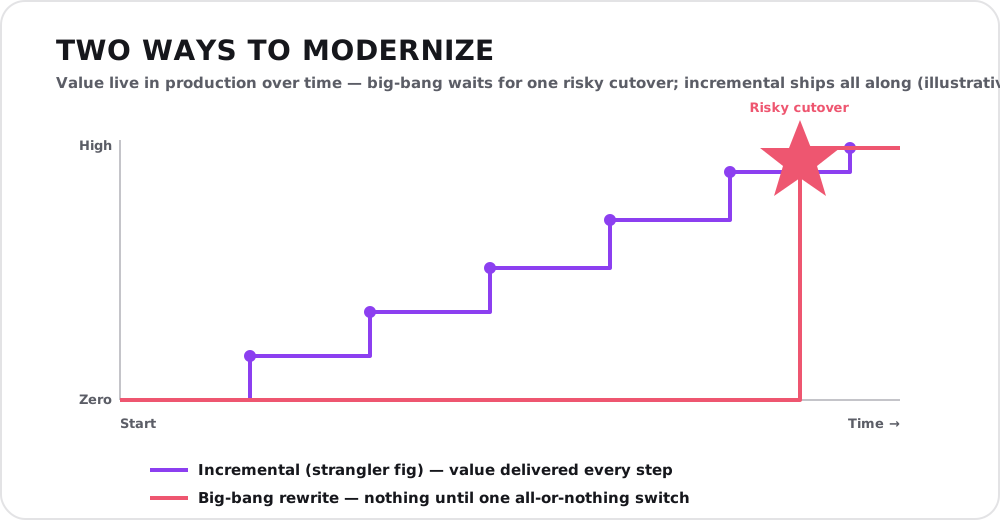
The core difference is not effort but shape. A big-bang rewrite delivers nothing until one all-or-nothing switch; the incremental approach in the next section puts working software in production the whole way through.
Your real options: the modernization spectrum
“Rewrite it” and “leave it alone” are the two ends of a spectrum, and the useful answers almost always sit in the middle. Before committing to anything, it helps to weigh each part of the system against the full menu of choices — often called the modernization “R” options:
| Option | What it means | Effort | Best when |
|---|---|---|---|
| Retain | Leave it as-is for now | None | It still works and there is no pressing pain |
| Retire | Switch it off — the need is gone | Low | The feature is unused or duplicated elsewhere |
| Rehost | Move it unchanged to new infrastructure (“lift and shift”) | Low | The code is fine but the hardware or data center is the problem |
| Replatform | Minor tweaks to fit a modern platform | Medium | Small changes unlock big operational gains (e.g. a managed database) |
| Refactor | Restructure the code without changing behavior | Medium | The logic is sound but the code is tangled and hard to change |
| Rearchitect | Reshape the design — e.g. split a monolith into services | High | The architecture itself blocks the business |
| Replace | Rebuild it, or buy an off-the-shelf product | High | The system is beyond saving or a good product now exists |
The point of the table is that modernization is a portfolio decision, not a single verdict. A realistic plan might retire two dead modules, rehost a stable one, and carefully rearchitect the single component that is genuinely holding the business back. If splitting a monolith is on the table, our guide to monolith vs microservices walks through that specific trade-off.
The strangler fig: modernize one piece at a time
When a core system does need real rework, the safest way to do it is not to replace it all at once but to strangle it slowly. The strangler fig pattern — named for the vine that grows around a host tree, gradually enveloping it until it can stand on its own and the original quietly disappears — is the modern default for exactly this reason.

The strangler fig grows around its host until the new form can stand alone and the old one quietly falls away — the same way new code envelops a legacy system one capability at a time.
The mechanics are straightforward. You put a routing layer (often an API gateway or proxy) in front of the legacy system so every request passes through it. Then you pick one capability, build a new implementation of just that slice, and switch the router to send the relevant traffic to the new code. The legacy system keeps handling everything else. You repeat this — one capability at a time — until there is nothing left running on the old system, and it can finally be switched off.
The advantages over a big-bang rewrite are exactly the things that make big-bang so dangerous, inverted:
- Risk is spread across many small, reversible steps instead of one irreversible cutover. If a slice misbehaves, you route traffic back to the legacy path.
- Value ships continuously. Each migrated capability is live and useful now, not after a two-year wait.
- The team learns as it goes, absorbing the old system’s hidden rules slice by slice rather than discovering them all on one terrifying launch night.
The trade-off is that you run old and new side by side for a while, which adds some complexity and discipline around the routing layer and shared data. For any system the business genuinely depends on, that is a bargain compared with the alternative.
A pragmatic playbook
Whatever mix of options you choose, a few principles keep a modernization on track:
- Start with the business case, not the technology. Modernize the parts that are actively costing you — slow releases, outages, compliance risk, blocked growth — and consciously leave the rest alone.
- Map before you cut. Document what the system does, what depends on it, and where the seams are. You cannot safely strangle what you do not understand.
- Never migrate without a test net. Characterization tests that capture the old system’s real behavior are what let you change it with confidence.
- Deliver in thin, live slices. Each step should reach production and prove itself. Long-lived branches and parallel builds are where modernizations go to die.
- Treat the data migration as its own project. Moving and reconciling data is usually harder than moving the code, and it is where cutovers most often fail.
When to bring in help
Modernization is high-stakes precisely because the system already matters. If the platform is central to how the business runs, the people who understand it are scarce, or a previous attempt has already stalled, an outside perspective is often the cheapest insurance you can buy. A good IT consulting partner can assess the system honestly, tell you which parts deserve investment and which should simply be retired, and design a migration that protects the business while it changes — and our software development team can then execute the strangler-fig build one safe slice at a time.
Conclusion
Legacy systems feel like a problem you have to solve in one heroic push, but that framing is exactly the trap. The reliable path is the patient one: understand what the system really does, pick the right response for each part of it, and — where real rework is needed — modernize incrementally so that risk stays small, value ships continuously, and you are never one bad cutover away from disaster. Old software does not have to be rewritten to be renewed.
If an aging system is quietly slowing your business down and you would like a straight assessment of what is worth modernizing — and how to do it without betting the company on a rewrite — reach out for a free consultation.