
Self-Service Analytics: How to Let Your Team Answer Their Own Data Questions
What self-service analytics really is, why the ungoverned version turns into chaos, and how to build governed data democratization — semantic layer, curated data, and data literacy — that scales.
- Data Analytics
- Self-Service Analytics
- Data Governance
- Business Intelligence

Every growing business hits the same wall. The data exists, the dashboards are built — and yet every real question (“which customers churned last quarter, and why?”, “is the new campaign actually profitable?”) still has to be routed to one overworked analyst or a small data team. The queue grows, answers arrive days later if at all, and by the time the number lands, the decision has already been made on a gut feel.
Self-service analytics is the answer most companies reach for: give people the means to answer their own data questions. Done well, it turns data from a bottlenecked service into a shared capability. Done badly, it replaces one problem — a slow queue — with a worse one: a company where every team has its own version of the numbers and no one trusts any of them.
This guide explains what self-service analytics really is, why the naive version fails, and how to build the governed kind that scales without descending into chaos.
What self-service analytics actually means
Self-service analytics is a way of working where non-specialists — a marketer, an operations lead, a finance manager — can explore data and answer their own questions without filing a ticket and waiting for someone to run a query for them.
It does not mean everyone writes SQL. It means the questions people ask most have been made answerable through tools they can actually use: interactive dashboards they can filter and drill into, a searchable catalog of trusted metrics, and curated datasets that are safe to slice without breaking anything. The specialist team shifts from answering every question to building the system that lets others answer questions — and reserves its own time for the hard, novel analysis that genuinely needs an expert.
The industry term for the goal is data democratization: making data accessible to the people who need it, at the moment they need it, regardless of their technical depth.
Why the analyst queue breaks down
In most companies, analytics starts life as a service desk. Someone needs a number, they ask the data team, the data team runs it. That works fine at five requests a week. It collapses at fifty.
- The queue becomes the bottleneck. Analysts spend their days pulling routine reports instead of doing the deep work only they can do, and the backlog grows faster than they can clear it.
- Answers arrive too late to matter. A number that takes four days to produce is useless for a decision that has to be made today.
- People stop asking. When the cost of a question is a week of waiting, teams quietly go back to deciding on instinct — which defeats the entire point of collecting the data in the first place.

When every question has to pass through one team, the queue itself becomes the constraint — requests pile up faster than they can be cleared.
The instinct is to hire more analysts. But that scales linearly and expensively, and it never quite catches up. The real fix is architectural: stop being the only door the data can come through.
The trap: self-service without governance
Here is where most attempts go wrong. A company buys a self-service BI tool, points everyone at the raw database, and declares data democratized. For a few weeks it feels like liberation. Then the cracks show.
Marketing defines “active customer” one way; finance defines it another. Two people build “revenue” reports from two different tables and bring incompatible numbers to the same meeting. Someone joins the wrong tables and quietly ships a dashboard that has been subtly wrong for a month. Trust in data — the very thing you were trying to build — erodes instead.
Uncontrolled democratization does not produce better decisions. It produces a fog of conflicting numbers where every team has its own truth and leadership cannot tell which one is real. The lesson the industry has learned the hard way: self-service without governance is just chaos with a nicer interface.
The alternative is not to retreat to the locked-down queue. It is governed self-service — the freedom to explore, built on a foundation everyone can trust.
| Approach | Central team only | Ungoverned self-service | Governed self-service |
|---|---|---|---|
| Who answers questions | The data team, via tickets | Anyone, on raw data | Anyone, on curated data |
| Speed to an answer | Days — you wait in line | Instant | Instant |
| Consistency of numbers | High — one team, one method | Low — every team its own truth | High — one shared definition |
| Analyst workload | Overloaded with routine pulls | Freed, but firefighting errors | Freed for deep work |
| Main risk | The bottleneck | Chaos and lost trust | Needs an upfront foundation |
Governed self-service keeps the speed of open access and the trust of a central team — the goal is the best column, not a swing between the first two.
The semantic layer: one definition of the truth
The single most important piece of governed self-service is the semantic layer — a shared, central definition of your business metrics and dimensions that sits between the raw database and the people asking questions.
Instead of everyone re-deriving “monthly recurring revenue” or “active user” from raw tables — and each getting it slightly wrong — the semantic layer defines each metric once, in one place, with the correct logic. Every tool, dashboard, and query that asks for “MRR” gets the same answer, calculated the same way. It is the difference between a dictionary everyone shares and everyone inventing their own private language.

The semantic layer is the single source every tool and person draws from, so the same question always returns the same, correctly calculated answer.
This is also what makes self-service safe for the AI-assisted analytics now arriving. When someone — or an AI assistant — asks a question in plain language, the semantic layer is what tells the system what “customer” and “churn” actually mean in your business, so the answer is grounded in a governed definition rather than a plausible-sounding guess.
The four foundations of governed self-service
Governed self-service rests on four things working together:
- Curated, trustworthy data. People explore prepared datasets — cleaned, joined, and documented by the data team — not the raw operational tables. This is where a reliable data pipeline and real data-quality discipline pay off: self-service is only ever as trustworthy as the data underneath it.
- A shared semantic layer. One agreed definition of every important metric, as above.
- Access and security guardrails. Row- and column-level permissions so people see exactly what they are allowed to see — no more, no less — and cannot accidentally expose sensitive data.
- Data literacy. Tools alone do not democratize data; people need enough fluency to read a chart honestly, question a suspicious number, and know the difference between correlation and cause. Enablement — training, documentation, and a culture that rewards asking — is the part most companies skip and most come to regret.
Take any one of these away and self-service tilts straight back toward either the bottleneck or the chaos.
The payoff: analysts do the work only they can do
The point of all this is not to eliminate the data team — it is to free it. When routine questions answer themselves, analysts stop being a report-generation service and start doing the work that actually moves the business: deep investigations, predictive modeling, and the kind of analysis a self-service dashboard will never produce on its own.
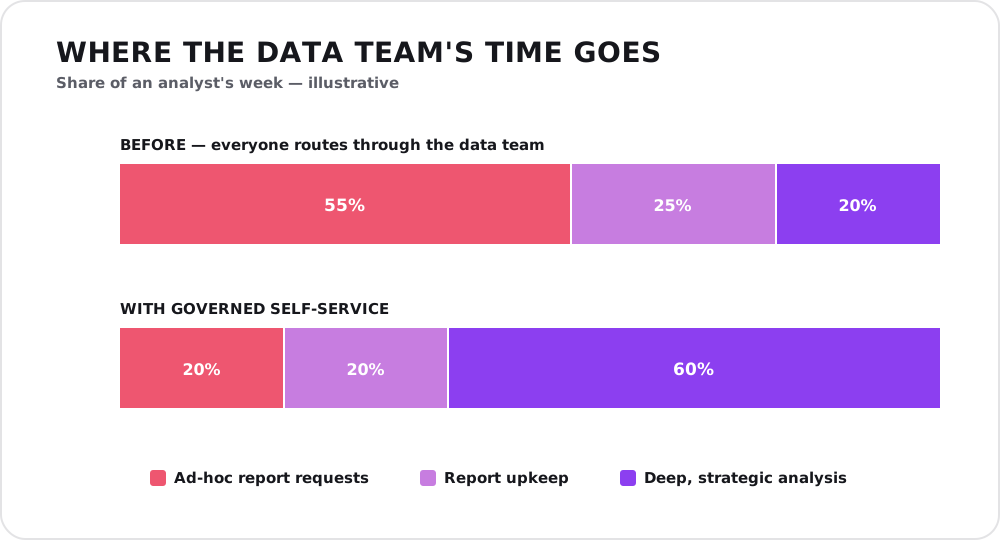
Illustrative split. The exact numbers vary, but the shape is the point: when routine questions answer themselves, the data team’s time shifts from pulling reports to the analysis only it can do.
The whole organization gets faster at the same time. Decisions that used to wait days for a number now happen in the meeting where the question was first asked. Data stops being a checkpoint and becomes a reflex.
How to start
You do not roll this out all at once. The companies that succeed start narrow and expand as trust builds:
- Pick one team and its top questions. Find the group drowning in report requests and map the ten questions they ask most. Those are your first self-service targets.
- Define those metrics once, centrally. Build the semantic definitions for exactly those metrics before you hand anyone a tool. Agreeing on definitions is harder — and more important — than any technology choice.
- Curate the datasets behind them. Give that team clean, documented, permission-scoped data to work with, never the raw warehouse.
- Build guided dashboards, then loosen. Start with interactive dashboards people can filter and drill into; graduate the confident users to freer exploration as their literacy grows.
- Invest in enablement from day one. Short training, clear documentation, and an obvious place to ask “is this number right?” do more for adoption than any feature ever will.
Expand one team at a time. Each success makes the next easier, and the governed foundation you built for the first team compounds for every team after it.
Conclusion
Self-service analytics is not a tool you buy — it is a capability you build. The naive version, everyone pointed at the raw database, trades a slow queue for a fog of conflicting numbers. The version that works pairs freedom with a foundation: curated data, a shared semantic layer, sensible guardrails, and a genuinely data-literate team.
Get that balance right and data stops being a bottleneck or a battleground. It becomes what it was always meant to be — a shared, trusted resource that everyone can draw on to make better decisions, faster.
If you are weighing how to give your teams self-service access to data without losing control of the numbers, that is exactly the kind of foundation our data analytics team helps businesses build. Reach out for a free consultation.