
Content Marketing Strategy: How to Earn Demand Instead of Renting It
A practical guide to content marketing for businesses — what it really is, how it differs from ads and SEO, mapping content to the buyer journey, distributing it, and measuring what matters.
- Digital Marketing
- Content Marketing
- Content Strategy
- SEO

Most businesses discover marketing through advertising: you pay, traffic arrives, and the moment you stop paying, it disappears. That is renting attention. There is another model that works the opposite way — you invest in creating something genuinely useful once, and it keeps earning attention, trust, and customers long after it is published. That is content marketing, and it is the closest thing in digital marketing to owning an asset instead of leasing one.
Content marketing is widely misunderstood as “writing blog posts” or “posting on social media.” It is neither of those tasks — those are just formats. At its core it is a strategy: consistently publishing content that answers your customers’ real questions, so that when they are ready to buy, they already trust you. This guide explains what content marketing actually is, how it differs from advertising and SEO, how to map content to the way people actually buy, and how to know whether any of it is working.
What content marketing actually is
Content marketing is the practice of attracting and retaining customers by creating and sharing valuable, relevant content — instead of pitching your products directly. A good article, guide, video, or tool helps someone solve a problem or make a decision. In doing so it earns something advertising cannot buy outright: credibility. The reader leaves better informed, and quietly associates that clarity with your business.
The economics are what make it compelling. An ad campaign is a faucet — it runs while money flows and stops when it does not. A strong piece of content is more like a well: expensive to dig, but it keeps giving. A guide that ranks in search and genuinely helps people can attract qualified visitors every month for years, at no additional cost per visit. That is why content marketing compounds while advertising merely accumulates.

Advertising is a faucet that stops when the money does; content is a seed that keeps growing. One good piece compounds into traffic and trust long after it is published.
This does not make advertising wrong — the two do different jobs. Here is how they compare on the dimensions that actually matter:
| Dimension | Content marketing | Paid advertising |
|---|---|---|
| How it works | Earn attention with useful content | Buy attention with budget |
| Time to results | Slow — weeks to months to compound | Fast — traffic the day you launch |
| What happens when you stop | Keeps working — the asset remains | Stops immediately |
| Cost over time | Falls per visit as content compounds | Constant or rising per click |
| Builds trust | Yes — that is the whole point | Rarely — most ads are skipped |
| Best for | Long-term demand and authority | Immediate reach, launches, promotions |
The honest takeaway is that these are partners, not rivals. Ads buy you reach today while your content builds an audience that costs nothing to reach tomorrow. The businesses that win use paid search to capture people already looking — the subject of our guide to Google Ads — while content marketing creates the demand that was not there before.
Content marketing is not the same as SEO
These two are so often conflated that it is worth separating them cleanly. SEO is the discipline of making your site findable in search — the technical health, the structure, the signals that help a search engine understand and rank your pages. It is about distribution. Content marketing is about the substance that gets distributed: the ideas, answers, and expertise worth finding in the first place.
They need each other. The best-optimized page in the world is worthless if it has nothing to say, and the most brilliant article will not be found if the technical foundation is broken. Think of SEO as the roads and content marketing as the destination worth driving to. If findability is your bottleneck, start with our SEO guide for businesses; if you have traffic but nothing that earns trust once it arrives, the gap is content.
Map content to how people actually buy
The most common content marketing mistake is treating every piece as a sales pitch. Most people who encounter your business are not ready to buy — they are still figuring out their problem. Content works when it meets people where they are in their journey, and that journey has three broad stages.
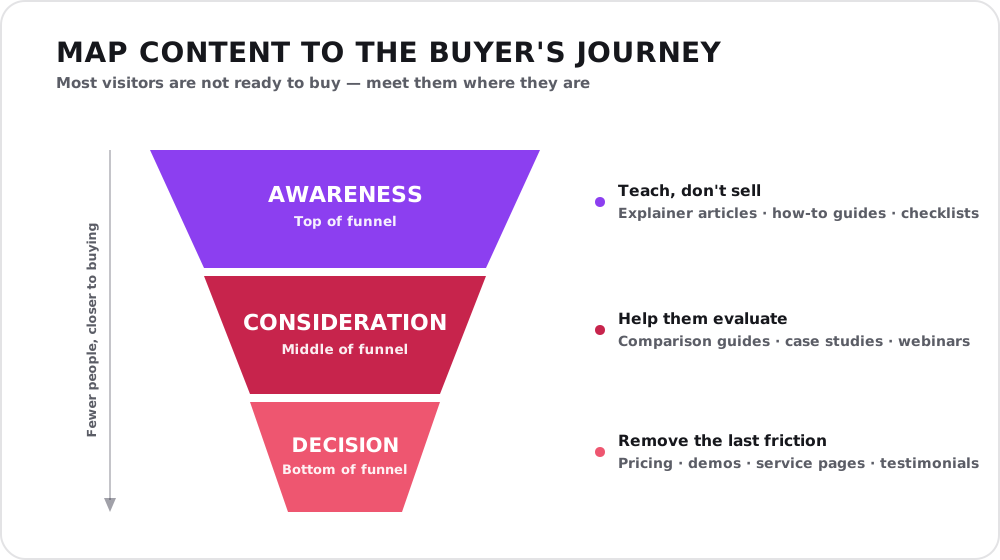
Different stages need different content. Balance all three — most businesses over-invest at the bottom and starve the top, where the larger audience is still forming its opinion.
Awareness (top of funnel). The person knows they have a problem but not the solution. They search things like “why is our website so slow” or “how to reduce data entry errors.” Content here is educational and generous: explainer articles, checklists, how-to guides. You are not selling; you are earning the first bit of trust by being genuinely helpful.
Consideration (middle of funnel). Now they are comparing approaches and vendors. Content here helps them evaluate: comparison guides, case studies, honest “how to choose” pieces, webinars. This is where you demonstrate expertise and show you understand the trade-offs — exactly what our comparison of custom software versus off-the-shelf SaaS is built to do.
Decision (bottom of funnel). They are ready to act and need a final nudge: pricing explanations, demos, detailed service pages, testimonials. Content here removes the last friction and makes it easy to say yes.
Most businesses over-invest in decision-stage content (which only reaches the small slice of people already ready to buy) and under-invest in awareness content (which reaches the far larger group still forming their opinion). Balancing across all three stages is what turns a blog into a pipeline.
Quality over volume — especially now
For years the content advice was “publish more.” That era is over. Search results and social feeds are saturated, and in 2026 a large share of searches are answered directly by AI summaries before a user clicks anything. The content that still wins is not the most frequent — it is the most useful and the most distinctive. One well-argued, genuinely original piece now outperforms a dozen thin, me-too posts that merely rephrase what everyone else already said.
This changes what “good” looks like. The durable advantage is publishing something competitors cannot easily copy: original data from your own work, hard-won lessons from real projects, a clear point of view, formats that are hard to fake. AI can help you draft and edit at scale, and most teams now use it — but it cannot supply the lived experience, the judgment, or the opinion that makes content worth trusting. Used well, AI handles the scaffolding; the substance and the voice have to be yours.
There is a practical SEO consequence too. As AI answer engines increasingly summarize content in place of linking to it, the way to remain visible is to be the clear, authoritative, citable source on a specific question — depth and originality, not keyword-stuffed filler. Thin content was already a weak strategy; it is now nearly invisible.
Publishing is half the job — distribution is the other half
A quiet truth of content marketing: hitting “publish” is the midpoint, not the finish line. Content that no one sees cannot build trust or demand, and the “if you build it, they will come” assumption is where most efforts stall. Every piece deserves a distribution plan, and most of that plan reuses channels you already have.
Share it through your email list — the one audience you fully own and can reach for free. Post it where your customers actually spend time, which for most B2B audiences means LinkedIn. Repurpose a single strong idea into several formats: an article becomes a short video, a few social posts, a slide, a newsletter section. And let the compounding channel — organic search — do its slow, patient work in the background while the active channels drive the early spike. One good idea, distributed well across formats and channels, beats five good ideas published and abandoned.
Measure what matters, not vanity metrics
Content marketing earns a reputation for being “hard to measure,” but that is usually a sign of measuring the wrong things. Page views and follower counts feel good and tell you almost nothing about business impact. The metrics worth tracking ladder up toward revenue:
- Qualified traffic — not raw visits, but visits from people who match your customer profile.
- Engagement that signals intent — time on page, scroll depth, returning visitors, and especially people who move from one article to the next.
- Leads and conversions — newsletter sign-ups, contact-form submissions, demo requests that you can trace back to a specific piece.
- Assisted revenue — deals where content played a role in the journey, even if it was not the final click.
The honest challenge is that content usually assists rather than closes, so simple last-click reporting will always undervalue it — which is exactly why marketing attribution matters for content more than for any other channel. Give it a fair measurement model and content stops looking like a cost center and starts looking like the compounding asset it is.
Common mistakes to avoid
- Expecting instant results. Content compounds over months, not days. Teams that quit after eight weeks abandon the investment right before it starts paying.
- Writing for search engines instead of humans. Keyword-stuffed pages read badly, convert worse, and now lose to genuinely helpful content anyway.
- Making everything a sales pitch. If every piece pushes your product, you never earn the trust that makes the pitch land.
- Publishing and forgetting. No distribution plan means no audience, no matter how good the writing.
- Inconsistency. Four strong pieces a year on a reliable cadence beat a burst of twenty followed by silence.
Conclusion
Content marketing is a long game, and that is precisely its advantage. Advertising rents attention for as long as you keep paying; content marketing builds an asset that keeps earning trust, traffic, and customers after the work is done. The strategy is not complicated — understand your customers’ real questions, answer them better than anyone else, map that content to how people actually buy, distribute it where they already are, and measure it honestly. What it demands is patience and consistency, which is exactly why most competitors give up and leave the field open.
If you want help building a content strategy that compounds — one grounded in your business, your customers, and the questions they are actually asking — that is a conversation we would enjoy. Reach out for a free consultation.