
How to Measure Marketing ROI: Attribution, and Knowing Which Marketing Actually Works
A practical guide to measuring marketing ROI — the metrics that matter, how attribution models credit each channel, and how to know which marketing actually drives revenue.
- Digital Marketing
- Marketing Analytics
- Attribution
- ROI

“Half the money I spend on advertising is wasted; the trouble is I don’t know which half.” The line is a century old, and for most businesses it is still uncomfortably true. You run ads, publish content, send email, show up on search — and revenue comes in. But which of those efforts earned the revenue, and which quietly drained the budget? Without an honest answer, you are not managing marketing; you are guessing with a bigger cheque each quarter.
This guide is about replacing the guess. It explains what marketing ROI really measures, why crediting the right channel is genuinely hard, how the main attribution models work — and how to build a measurement habit that tells you where your next marketing dollar should go.
What “marketing ROI” actually measures
At its simplest, return on investment asks: for every dollar you put into marketing, how many dollars of value came back? But the headline number hides several distinct questions, and confusing them is where most measurement goes wrong.
- ROI — profit generated relative to total marketing cost. The strategic number the business ultimately cares about.
- ROAS (return on ad spend) — revenue divided by ad spend, usually for a single channel or campaign. Useful and immediate, but blind to margin and to everything that happens off that channel.
- CAC (customer acquisition cost) — what it costs, all-in, to win one new customer. The denominator of almost every growth decision.
- CLV (customer lifetime value) — the total profit a customer produces over the whole relationship, not just the first sale.
The mistake that quietly wrecks budgets is optimising for the wrong one. A channel with a dazzling ROAS on first purchase can still lose money if it attracts customers who never come back — while a “worse” channel brings in buyers whose CLV pays for itself ten times over. The pair that actually governs sustainable growth is CLV against CAC: as long as a customer is worth comfortably more than it costs to acquire them, you can afford to spend to grow.
Why measurement is genuinely hard
If every customer saw one ad and bought immediately, measurement would be trivial. Real buying journeys look nothing like that. Someone finds you through an organic search, forgets about you, sees a retargeting ad two weeks later, reads a comparison article, clicks an email, and finally converts by typing your name straight into the browser. Which of those six touches “caused” the sale?

One sale, many touches: the revenue arrives at the end of a long chain, and every link wants the credit.
Modern journeys are long and crowded — commonly a dozen or more touchpoints spread across weeks or months, on multiple devices. This is the attribution problem: the revenue is real, but it arrives at the end of a chain, and deciding how much credit each link deserves changes which channels look like heroes and which look like waste.
It has become harder, not easier. As third-party cookies fade and privacy rules tighten, the browser signals marketers once relied on are disappearing. Increasingly, the honest picture depends on first-party data — the events you collect yourself, about your own customers, on your own systems.
Attribution models: the same sale, credited many ways
An attribution model is simply a rule for splitting the credit for a conversion across the touchpoints that preceded it. Change the rule and the same campaign can look brilliant or pointless. There is no single “correct” model — only ones that fit different questions. Here are the ones that matter.
| Model | How it assigns credit | Best for | Blind spot |
|---|---|---|---|
| Last-click | 100% to the final touch before converting | Short journeys; quick, simple reporting | Ignores everything that created the demand |
| First-click | 100% to the first touch that found the customer | Judging top-of-funnel discovery | Ignores what closed the sale |
| Linear | Split evenly across every touch | Valuing the whole journey fairly | Treats a throwaway touch like a decisive one |
| Time-decay | More credit to touches nearer the conversion | Longer sales cycles where recency matters | Undervalues the awareness that started it all |
| Position-based | ~40% first, ~40% last, 20% shared across the middle | Valuing both discovery and closing | The weights are a rule of thumb, not a measurement |
| Data-driven | Credit learned from your own conversion patterns | High-volume accounts with enough data to model | Needs volume, clean data, and is harder to explain |
The jump worth understanding is from single-touch models (first- or last-click, which hand all the credit to one moment) to multi-touch models (linear, time-decay, position-based, data-driven, which spread it across the journey). Single-touch is simple and often badly misleading: last-click flatters the channels people use when they are already convinced — branded search, direct visits — and starves the earlier channels that created the demand in the first place. Multi-touch is closer to the truth, at the cost of more data and more care.
To see why this matters, watch what happens to one channel’s apparent value as you change nothing but the model:
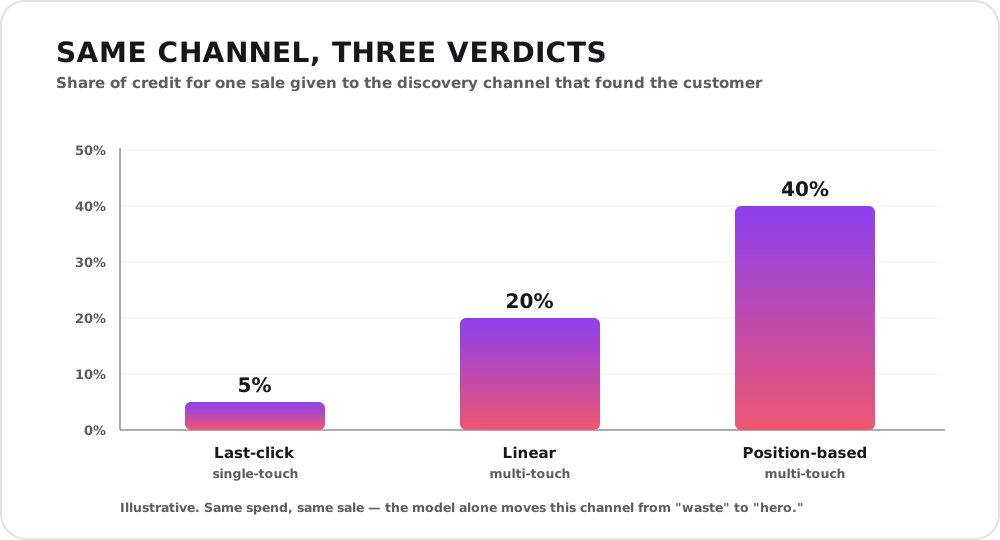
The same discovery channel, credited three ways for one identical sale. Nothing changed but the model — yet last-click would have you cut the very channel that started the journey.
Same spend, same sales — a wildly different verdict. That is exactly why the model is a business decision, not a technical footnote: it silently decides which parts of your marketing get more budget next quarter.
Which model should you use?
Start with the honest state of your data, not with the fanciest option.
- If your journeys are short and volume is low, last-click is a defensible starting point — just name it for what it is, and don’t use it to kill your awareness channels.
- If you have a real funnel — discovery, consideration, decision — move to a multi-touch model. Position-based is a pragmatic default: it rewards both the channel that found the customer and the one that closed them.
- If you have high conversion volume and clean tracking, data-driven attribution can learn the weights from your own history instead of guessing them. It is only as good as the data underneath it, which is why data quality is a prerequisite, not a nice-to-have.
Whatever you pick, the discipline is the same: compare channels within one model, and change the model deliberately, knowing it will reshuffle the rankings.
Beyond models: incrementality and the metrics that matter
Attribution answers “which touches got credit?” It does not answer the harder question: “would this sale have happened anyway?” A retargeting ad shown to someone already walking to the checkout will hoover up credit while adding nothing. The remedy is incrementality testing — deliberately holding back a channel or audience and measuring the difference in outcomes, not just the conversions that carried a tag. It is the closest marketing gets to a controlled experiment, and it is the surest way to catch spend that looks productive but changes nothing.
The other discipline is refusing to drown in numbers. A dashboard with fifty metrics hides the five that decide anything. For most businesses those five are CAC, CLV, ROAS by channel, conversion rate, and payback period — the time it takes a new customer to earn back what you spent to acquire them. Improving conversion is often the fastest lever of all, which is why measurement and conversion rate optimization belong together: attribution tells you where to spend, CRO makes each visit worth more.
Building the measurement, not just buying a tool
Good measurement is a system, not a subscription. In practice it rests on a few foundations:
- Define the conversions that matter — and their value. A newsletter signup, a qualified lead, and a paid order are not worth the same; your model should know it.
- Collect first-party data reliably. As browser signals erode, server-side tracking — sending conversion events from your own systems rather than the browser — is what keeps measurement accurate. It is an engineering task as much as a marketing one.
- Unify the sources. Ad platforms, analytics, your CRM, and your billing system each hold a fragment of the truth. Bringing them into one place — the job of a data pipeline feeding a BI dashboard — is what turns scattered numbers into a decision you can trust.
- Review on a cadence. Measurement that nobody looks at is theatre. A monthly ritual of “what did each channel cost, earn, and prove?” is where the budget actually gets reallocated.
None of this requires a giant platform on day one. It requires clear definitions, clean data, and the honesty to act on what the numbers say — even when they say your favourite channel is coasting on other people’s work.
Conclusion
Marketing ROI is not a single number you look up; it is a question you learn to answer well. Get the metrics right — CAC against CLV, not vanity ROAS. Choose an attribution model deliberately, knowing it decides which channels get the credit. Test for incrementality so you fund what actually moves the needle. And build the measurement on first-party data you own, unified into one honest view.
Do that, and Wanamaker’s lament finally loosens its grip: you may never know exactly which half of the budget was wasted, but you will know enough to spend the next dollar where it works — and that is what separates marketing that compounds from marketing that merely spends.
If you want help turning scattered marketing and sales data into one trustworthy picture of what is working, that is squarely the kind of problem our digital marketing and data teams solve together. Reach out for a free consultation.